


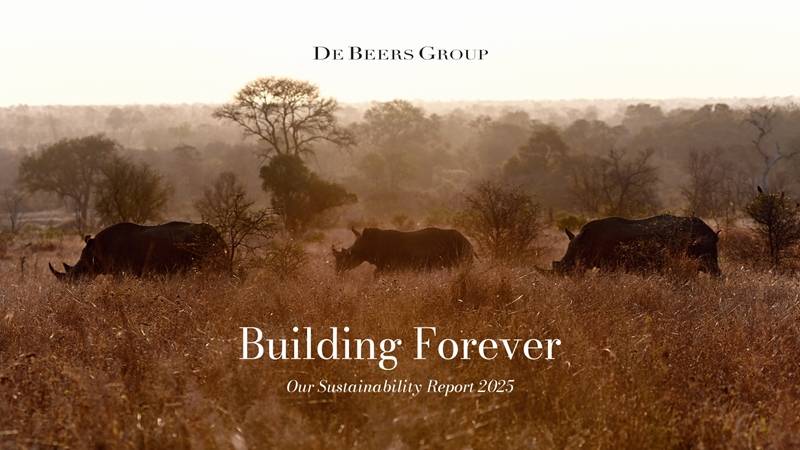

De Beers Group has reported a 14% reduction in its Scope 1 and 2 emissions since 2021 and said more than five million rough diamonds have now been individually registered on Tracr.
The figures appear in its 2025 Sustainability Report, which also covers conservation, employment and training across its diamond-producing partner countries.
Climate and Conservation
The emissions reduction puts De Beers partway towards its target of cutting its carbon footprint by a third by 2030. The group said its next priorities include expanding renewable energy capacity, electrifying mining equipment and working with suppliers on Scope 3 emissions, which fall outside its direct operations.
De Beers said it manages 375,000 acres of land for conservation in Southern Africa. It also reported that a partnership with National Geographic supported the designation of Angola’s first Ramsar Wetland, at the source of much of the water flowing into the Okavango Delta. In Botswana, the group said 31 rhinos were relocated as part of regional conservation work.
Jobs and Skills
De Beers reported that it supported 2.6 offsite jobs for every onsite job created in 2025, against a target of four by 2030. Its EntreprenHER programme trained a further 500 women during the year, bringing the reported total since 2016 to more than 3,900.
The group has also committed approximately US$70 million to a Diamonds for Development Fund in Botswana. Its other programmes include support for small businesses involved in cutting, polishing, jewellery design and trading. These figures give jewellers specific information about employment and training connected to the company’s diamond supply chain, while the results of the new fund have yet to be reported.
Provenance and Industry Standards
De Beers said Tracr passed five million individually registered rough diamonds in 2025. The platform has partnered with Sarine to connect rough diamond source registration with scanning data. The company identified wider participation by producers and midstream businesses as a priority for expanding the system.
Rough diamond registration is one stage of documenting provenance. For retailers making claims about an individual polished stone, the relevant question remains what records accompany that stone through cutting, polishing and sale.
The report also marks 20 years of De Beers’ Best Practice Principles programme, which the group says covers its operations, Sightholders and their diamond-related contractors and is subject to third-party audit.
Al Cook, Chief Executive Officer of De Beers Group, stated: “At De Beers, we believe natural diamonds can do more than sparkle. Through the natural diamond value chain, they can support jobs, skills development, nature conservation and climate action in diamond-producing countries. During 2025, De Beers Group sharpened its focus on a set of ambitious sustainability targets where the business can make the greatest difference, aligned with partner country priorities, global standards and UN Sustainable Development Goals. We are proud of the progress we are making to ensure every diamond we recover creates lasting impact for people, communities and the environment, but we also understand that this requires sharp focus, deliberate action and constant monitoring. As the pace of change around us increases, and as the risks and opportunities ahead of us become clearer, so must our commitment to progress grow.”
Sandrine Conseiller, CEO, De Beers Brands, further added, “We’re pleased to share our 2025 sustainability achievements, demonstrating that our ambitions can lead to real, impactful change. Consumers increasingly expect the brands they choose to consider their wider impact, not as something exceptional, but as a matter of course. This report is about showing what De Beers’ sustainability commitments mean in practice, sharing openly the actions we are taking and the impact we are having, so customers can choose natural diamonds with confidence, knowing the value they create reaches far beyond the diamond itself.”
